I'm probably one of the last bloggers to pay tribute to the late, great David Bowie in the week he died, and many many bloggers have expressed their sadness at his passing in far more eloquent and elegant ways than I could ever hope to.
Whilst perhaps not a Bowie fanatic per se, I am a big fan and ardent admirer, and was lucky enough to see the man himself play live at the Liverpool Royal Court in 1997. Even so, I did not expect the wave of melancholy and loss that came over me this week; no tears, but a real sense of lament; a sense that something has changed.
Many of us have reached for and sought solace in Bowie tracks this week. Some have gone for the better known classics, some for the earlier or later, more obscure tracks. Some, like my good friend and blogger Tim Worthington, went straight for the underrated Tin Machine.
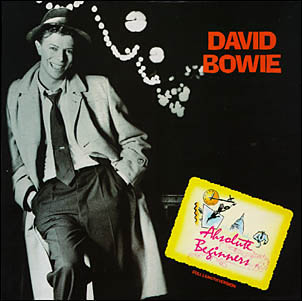
All good, valid options. But despite my love of the many different phases of Bowie, there was only one track for me: the sublime Absolute Beginners.
Written by Bowie for the much-hyped 1986 film musical of the same name, Absolute Beginners was a contemporary record which evoked the 1950s period, even if it didn't sound like a 1950s record. Bowie combines a retro 1950s sound with the 80s pop-jazz sound to create a heartfelt, irresistible anthemic ballad which manages to balance optimism and melancholy.
The track was co-produced by Bowie with Clive Langer & Alan Winstanley, who masterminded the entire film soundtrack album. Langer & Winstanley's production partnership is probably most linked to their work with Madness, and interestingly enough, there is something of the mid-80s downbeat Madness sound to the track. Indeed, it's a shame that there were no further collaborations between Bowie and Langer & Winstanley beyond this track and That's Motivation (also featured in the film).
It's a lush, real-sounding record; with a real cinematic sweep, even when considered separately from the film. Kicking off with a “ba-ba-bow-woo” vocal hook, and carried along with some irresistable saxophone, the song simply screams class. Bass, percussion and piano all add to the jazz vibe, giving a very different but complementary environment for Bowie's unmistakable voice. “I've nothing much to offer / I've nothing much to take” he opines, before heading to the bridge which contains the song's title (as opposed to the more standard practice of using it in the chorus).
The chorus is a shaft of sunlight between the clouds, a blast of optimism which deviates from the considered melancholy of the verses. "If our love song / Could fly over mountains / Sail over heartaches / Just like the films / There's no reason / To feel all the hard times / To lay down the hard lines / It's absolutely true".
Eventually, Bowie builds up to one last cry of the chorus – “It's absolutely true...” – and then gives way for the players, who take charge of a lengthy coda, which is heartbreakingly, spine-tinglingly moving, you never want it to end.
The musicianship and playing on the track is astonishing -- the band includes Rick Wakeman on piano, whilst Luis Jardim contributes percussion -- and the instrumental Dub Mix of the track shows this off to great effect.
There were three versions of Absolute Beginners released; the 7" version, which comes in at a surprising 5 and a half minutes; the eight-minute Full Length Version, and a Dub Mix (an instrumental version of the Full Length Mix). All are worth a listen -- repeated listens, in fact -- though the Full Length Version is the definitive take. Don't dismiss it as a standard 80's 12" mix, padded out to fill one side of vinyl -- this is a sumptuous, lush performance; it's as heartbreaking as it is inspiring.
Artistically and commercially, Bowie's song outperforms and transcends the parent film; a number #2 hit in the UK charts, it's also considered as one of his best 1980s tracks. But a word for the film too -- much-hyped, underperformed at the box office and largely derided it may have been, but I think Absolute Beginners does not deserve the bad rap it has gained over the years.
As someone who has read Colin MacInnes' original novel and seen the film many times, it is clear that the film is a heightened, authored take on the source material, rather than a faithful adaptation. True, it may not gel properly as a cohesive whole and some of the performances let it down, but its sheer ambition and breathtaking set-pieces deserve some praise. The opening motion shot of 1950s Soho is terrific, as is Bowie's electrifying performance of That's Motivation as he stands on the keys of a giant typewriter!
That's one of my favourite images of Bowie. Larger than life, even when dwarfed by a giant typewriter.
Absolute Beginners is an interesting film, but the title track carries so much meaning for me on many levels. I never get tired of it, but I'm always careful not to overplay it, not let it overstay it's welcome. Some things should be treasured, after all.
Unquestionably one of my favourite records, and yet another example of the diversity of the genius that is, was, and will always be, David Bowie.
1986 was an interesting year for Stock Aitken Waterman. The writing and production team had only been together for two years, but had already achieved significant success with their early work for acts such as Divine, Hazell Dean, Dead Or Alive and Princess. 1986 would see the team experiment with a number of different styles and genres, before finding a niche in the dance-pop style that would take them into the stratosphere, and some of their most interesting records were made during this period.
Perhaps the most surprising releases during this phase was a delightful trio of singles which saw the triumvirate tackle a bit of Brazilian bossa nova & latin jazz.
First up was Mondo Kane -- which appears to have been Stock Aitken Waterman undercover as a studio band, albeit fronted by the team's regular backing singers Dee Lewis and Coral Gordon -- and their debut single, New York Afternoon.
New York Afternoon was written by US jazz saxophonist Richie Cole, who originally recorded it in 1977 with Eddie Jefferson on vocals. This original version has a very traditional jazz feel, with an arrangement led by piano, bass, and of course, saxophone. As the title suggests, the song relates the lazy Sunday afternoon enjoyed by two lovers as they wander through New York in June, making memories that "We'll remember / When skies are grey and snow's fallin' in December / That was a New York afternoon". It's a very accessible, well-performed track, benefiting from Jefferson's rich voice -- and scatting!
Whilst the Mondo Kane take on New York Afternoon would retain the jazz influence of the original, Stock Aitken Waterman introduced a bossa nova element -- resulting in a sound tipping its hat to artists such as Herb Alpert and Sergio Mendes. Indeed, Mike Stock has commented that the Sergio Mendes & Brasil '88 version of Waters of March (from the 1978 album Brasil '88) was an influence on the Mondo Kane sound. It's an inspired decision, as the Mondo Kane version of New York Afternoon is simply joyous.
Opening with a chirping bird flute riff (which would recur throughout the track), the track is carried along with some fine nylon guitar, sharp bass and high-hat, bass drum and cross-stick percussion. The Jefferson role on the Mondo Kane version was taken by guest vocalist Georgie Fame, the legendary jazz / R&B singer, and his mellifluous vocals brings an extra dimension to proceedings, although Lewis and Gordon are less prominent as a result. The track also includes a terrific saxophone solo (alas uncredited); the addition of real brass always lifted a Stock Aitken Waterman track, as it does here.
Mondo Kane - New York Afternoon: Extended Version
In addition to the main 7" mix, there was an Extended Version (which really highlights the fine playing by Mike Stock, Matt Aitken and then-regular keyboard player Andy Stennett), the Nip On mix (which omits Fame's lead vocal, allowing Lewis and Gordon their moment in the sun), and the Little Samba Mix (which appears to be a re-edit of the 7" mix). The B-side was an original Stock Aitken Waterman instrumental composition, Manhattan Morning, which is the vein of the A-side, but with a more modernistic arrangement -- a pleasant listen all the same. Phil Harding was on mixing duties for all the above.
The single was released on Lisson Records, a label run by music industry legend and PWL A&R Tilly Rutherford, but despite some fair promotion, the record peaked at #70 in the charts. A word for the sleeve, which takes the look of a 1940s film poster. Announcing "A Fiesta of Music", it lists the song title and performers in a billboard style, with prominent credit for the producers -- indeed, in line with the film poster theme, the front cover carries a "Produced and Directed by Stock Aitken Waterman" statement. The rear of the sleeve, unusually, carries a detailed description of the recording techniques and facilities of PWL Studios!
The sleeve also carries a credit for soul DJ (and Georgie Fame fan) Chris Hill as A&R Co-Ordinator, which would suggest that he was responsible for Fame's involvement and would indeed play a significant role in the second of the three tracks we're looking at.
Our second track is Samba (Toda Menina Baiana) by Georgie Fame. A cover of the 1979 Gilberto Gil track Toda Menina Baiana (retitled Samba for this release, although the original title was used as a subtitle) with English lyrics by Fame, the song title translates as "Every Bahian Girl", referring to the Bahia state of Brazil. The song itself discusses the good and bad qualities of the "Bahian girl", indicating that this duality is God's will.
Samba saw Mike, Matt and Pete develop the bossa nova sound further; if anything, it leaned even further towards the Brazilian elements found in the Gil original. Ambling along with classic bossa nova percussion, nifty bass and flute, the low-key arrangement allows Fame's voice to take centre stage. Fame is at ease with both his English lyrics and the original Brazilian Portuguese lyrics, and his light scatting during the chorus is nicely done. Lifted by the bright backing vocals, handclaps and lovely trumpet, it's a delightfully uplifting track with a real summer feel -- and it's almost a shame that this was released late Autumn/early Winter.
Georgie Fame - Samba: Toda Menina Baiana Mix
Alongside the main 7" mix, there was the Toda Menina Baiana Mix (which is a straight extended version) and a further 12" remix, Ipanema Beach Party Mix (which interpolates elements of Fame's Yeh Yeh, and Astrud Gilberto's Girl From Ipanema amongst others). The 7" and 12" mixes were by Pete Hammond, with the Ipanema Beach Party Mix by Phil Harding.
The single was released on Ensign Records (a subsidiary of Chrysalis Records); Chris Hill was A&R at Ensign, and was credited as Executive Producer. One account has it that Samba was apparently especially recorded by Fame & Stock Aitken Waterman for a soul weekender in South Wales, but either way, the concept is credited to Hill on the sleeve. Unfortunately, the single stalled at #81, but it's another interesting diversion from what is regarded as the typical Stock Aitken Waterman sound -- and well worth checking out.
The final record of the three bossa nova tracks is the second (and sadly last) Mondo Kane single, which was released in late 1986. An Everlasting Love (In An Ever-Changing World) (The Doop De Do Song) was an original Stock Aitken Waterman composition, again performed by Lewis and Gordon but sans Fame this time.
An Everlasting Love (In An Ever-Changing World) (The Doop De Do Song) carried the sonic hallmarks of its predecessor -- nylon guitar, latin percussion -- but introduced some different elements such as synth pads, drum fills and electric piano. This broadened the sound but without losing the bossa nova basis. Lewis and Gordon's vocals are lovely, switching between the breathless delivery of the verses and the buoyant singalong of the catchy "do-do do do do do do do-do do do do do do" chorus refrain. There's definitely more of a pop vibe to this track but that's no bad thing; it still benefits from a shimmering latin jazz sound and is a charming listen.
Mondo Kane - An Everlasting Love (In An Ever-Changing World) (The Doop De Do Song): A Foggy Day In London Town Mix
This release only had three mixes: the Radio Edit, A Foggy Day In London Town Mix (both mixed by Pete Hammond) and an Instrumental version (mixed by Phil Harding).
As before, the single was released by Lisson Records, with pretty much the same front sleeve (albeit with different colours and text). The rear sleeve again carried the technical blurb about PWL Studios -- which incidentally ends with "As PW (Pete Waterman) always says, "always remember you can't hum a bass drum"!! Unfortunately, this single fared less well than even New York Afternoon and Samba, and appears not to have made the Top 100.
Stock Aitken Waterman's intriguing experiment into bossa nova and latin jazz largely came to an end with the final Mondo Kane single release. One factor must surely be the failure of these three singles to reach the Top 40 but it should also be considered that by the end of 1986, Stock Aitken Waterman had had hit singles with Bananarama's Venus and Mel & Kim's Showing Out (Get Fresh At The Weekend) -- these successes would suggest that Stock Aitken Waterman had found the new sound they had been looking for, and this would indeed be the case. As a result, there was perhaps less of a need to explore the sound adopted by the Mondo Kane and Georgie Fame singles. Whilst Stock Aitken Waterman would not return to this genre wholesale, they would include latin jazz elements in subsequent tracks, such as The Cool & Breezy Jazz Mix of Mandy Smith's I Just Can't Wait, and the Jazz Mix of Erik's The Devil and The Deep Blue Sea.
Whilst the influence of Sergio Mendes has been cited, it should also be noted that acts like Matt Bianco and Working Week had enjoyed some success with a latin jazz / bossa nova sound in that mid-1980s period. However, the interest in these acts chartwise was waning at the point these three Stock Aitken Waterman productions were issued (though it is fair to say that Matt Bianco went on to sustain a good level of global success and continue still to this day). Indeed, the Mondo Kane records are unfairly classed by some commentators as Matt Bianco rip-offs, which is simply a lazy comparison. If anything, the three tracks covered here all benefit from Stock Aitken Waterman merging their pop sensibilities with this jazz-funk genre, resulting in contemporary records which make a respectful nod to traditional styles.
All three tracks remain interesting examples of the versatility of Stock Aitken Waterman as producers, and demonstrate that they were capable of much more than their trademark style suggests. Best listened to if you fancy groovin' on a New York Afternoon, or indeed, on a Manhattan Morning...


:format(jpeg):mode_rgb()/discogs-images/R-906248-1369903561-2104.jpeg.jpg)
:format(jpeg):mode_rgb()/discogs-images/R-4125624-1362315488-3963.jpeg.jpg)
